THE AURORA BRIEF
The world, in perspective.
MONDAY EDITION · THE WEEK AHEAD
Oil Falls.
Risk Doesn’t.
China’s economy finds momentum, energy markets confront an uncertain geopolitical bargain, and a pivotal earnings week tests the foundations of the AI boom.

Good Morning
A week of better headlines.
Harder questions remain.
THE EDITOR’S NOTE
Welcome to the inaugural edition of The Aurora Brief. The defining question this Monday is whether apparent improvements in economic conditions represent genuine progress—or temporary relief from deeper problems. Oil prices are retreating, but geopolitical threats to supply remain. China's economy has beaten expectations, but domestic demand is struggling. Technology companies are investing extraordinary sums in artificial intelligence, while investors increasingly question the returns. Meanwhile, Sweden begins another week without a newly formed government.
The common thread is uncertainty about what happens after the initial headline. That's where today's reporting begins.
The Morning Ritual
WORD OF THE DAY
Optionality
Noun · Economics and strategic management
The value of preserving choices when future circumstances are uncertain.
Example: "By maintaining relationships with multiple suppliers, the manufacturer preserved optionality during the energy crisis."
Optionality is especially valuable when decisions are expensive or difficult to reverse.
QUOTE OF THE DAY
"The difficulty lies, not in the new ideas, but in escaping from the old ones."
THE CURRENCY DESK
USD / SEK
1 USD = 9.9119 SEK
1 SEK ≈ 0.1009 USD
Reference: Friday, 16 October 2026 closing rate. This is the latest completed weekday session used for today's comparison, not a live executable quote.
TODAY'S JEOPARDY CHALLENGE
Category: Economic History
This British economist developed the theory of comparative advantage, explaining why countries can benefit from international trade even when one is more productive at making everything.
Your answer: Who is ________?
Reveal the answer
Who is David Ricardo? See the explanation near the end of this edition.
The answer awaits near the end of today's edition.
John Maynard Keynes · The General Theory (1936), preface.Investing.com Canada · USD/SEK history ↗
Keynes · The General Theory, preface ↗
The Front Page
Today's Five Most Important Stories
Ranked by their potential consequences for international affairs, economic activity and the week ahead.
01 ENERGY & GEOPOLITICS
Oil prices retreat as Washington considers easing Russian sanctions, but Gulf shipping risks remain elevated.
Brent futures fell 1.6% to $108.06 per barrel in the early snapshot used in this edition. The market is assessing possible sanctions relief alongside continuing security threats around the Strait of Hormuz.
Read the story →
02 GLOBAL ECONOMY
China's economy grows 4.5% in the third quarter, exceeding forecasts.
The result improves on the previous quarter's 4.3%, but export strength continues to mask weak domestic demand and investment.
Read the story →
03 EUROPEAN SECURITY
Russian airstrike kills a woman in Kyiv and damages a subway station.
The attack comes amid renewed American intelligence cooperation with Ukraine and continuing diplomatic efforts to end the war.
Read the story →
04 TECHNOLOGY & MARKETS
The AI investment boom faces a critical earnings test.
After significant losses in semiconductor shares last week, investors will examine whether technology companies can justify their rapidly expanding infrastructure spending.
Read the story →
05 SWEDEN & POLITICS
Sweden's government-formation deadlock continues after parliament rejects Magdalena Andersson.
Last Thursday's vote ended 248–99 against her appointment. The Speaker is expected to provide information about the next steps today.
Read the story →Photographs are illustrative file images. Individual photo credits appear with the corresponding articles.
The Lead Story
Oil Falls. Risk Doesn't.
A geopolitical concession offers temporary relief to global energy markets. Monday's early trading illustrates a fundamental distinction between the financial price of a commodity and the actual cost of delivering it. Oil futures have declined following signals that the United States may ease certain sanctions affecting Russian petroleum exports. In the early snapshot used here, Brent crude futures fell 1.6% to $108.06 per barrel, while U.S. crude futures declined 0.7% to $100.70.
Those declines were sufficient to improve sentiment in U.S. equity futures and government bonds. However, the underlying supply picture remains considerably more complicated. Iran reported another tanker striking a mine in the Strait of Hormuz; this is an attributed report, not independently verified here. The United States has also left uncertainty surrounding the precise scope and implementation of any Russian sanctions relief. Secretary of State Marco Rubio indicated that the administration could take up to 60 days to evaluate its economic implications.
Consequently, the prospect of additional Russian supply does not necessarily mean additional barrels will reach consumers quickly.
Why this matters
Energy costs affect considerably more than motorists. Oil influences shipping, aviation, chemical manufacturing, agricultural production and industrial logistics. Higher fuel costs can spread through the economy even when a company's direct petroleum consumption is relatively small. Consider a European manufacturer purchasing components from Asia. Its exposure might include transportation fuel, supplier electricity costs, freight insurance and the energy required to produce raw materials. A decline in oil futures could improve some of those costs, but the benefit may be offset by rising shipping premiums or supply disruptions.
That distinction is particularly relevant for Sweden's export-oriented industrial economy.
The Developing Story
What we know: Oil futures have declined, and Washington has waived some sanctions while leaving its final policy decision under review. What remains uncertain: The final scope and durability of those changes, how much additional supply they could generate, and whether shipping disruptions will intensify. What comes next: Further U.S. policy clarification, developments around Gulf shipping routes and the response of physical energy markets. This becomes one of our inaugural Stories to Follow. Future editions will explain what materially changed rather than simply repeat the background.
02 The Global Economy
China Is Growing Faster. Is It Growing Better?
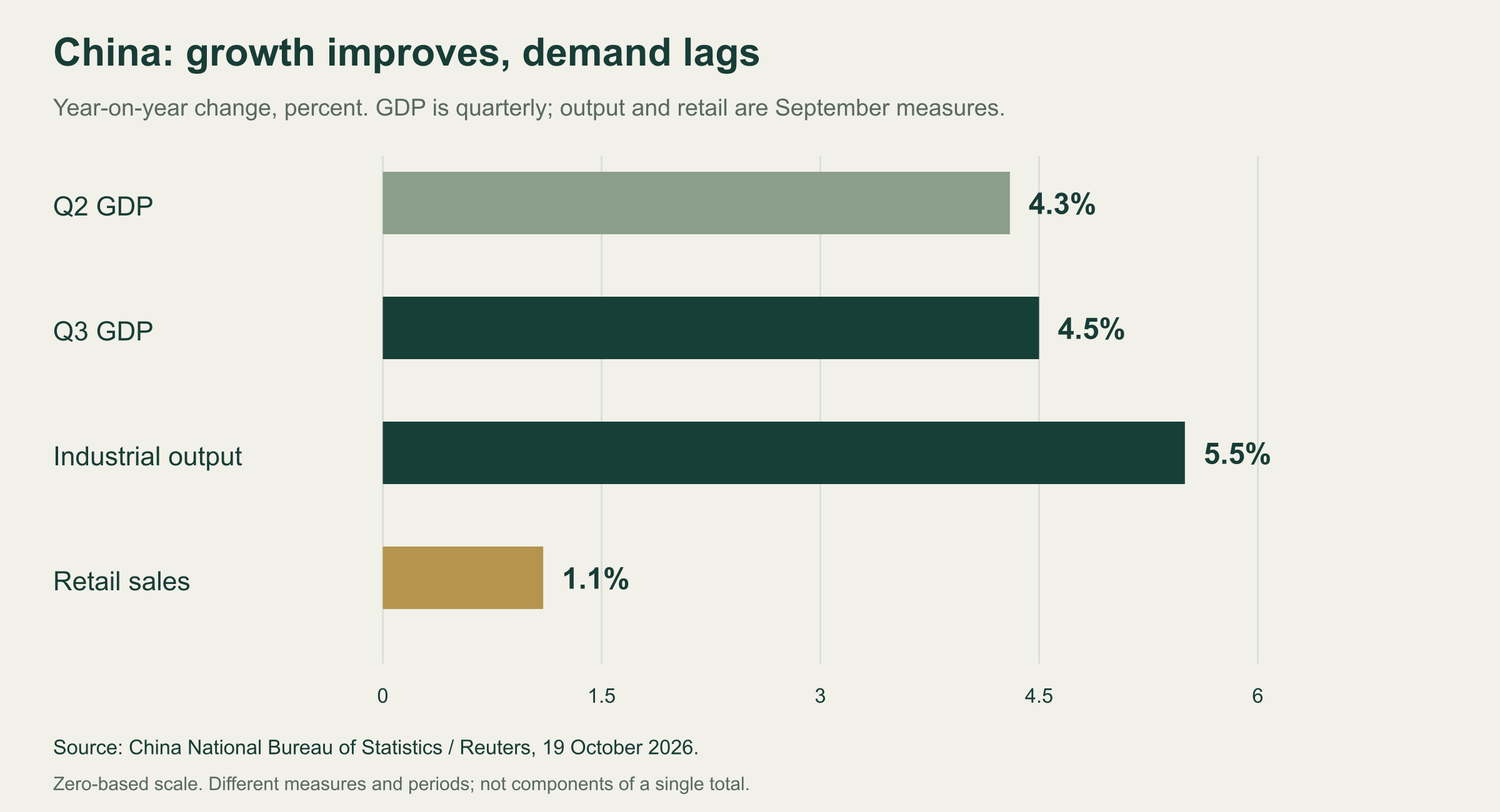
China reported third-quarter GDP growth of 4.5% year over year, exceeding the 4.4% forecast in a survey. That represents an improvement from the second quarter's 4.3%. On a quarterly basis, the economy expanded 1.2%. Industrial production increased 5.5% in September, while retail sales rose 1.1%. These figures provide some relief to policymakers attempting to achieve the country's annual growth target. But the headline conceals an important imbalance.
Export-oriented manufacturing remains considerably stronger than domestic consumption and property investment.
Two Different Chinese Economies
China's export economy benefits from international demand for manufactured products, electronics and advanced technology. Its domestic economy faces different challenges. A prolonged property downturn has weakened household confidence and reduced investment. This matters because a country cannot indefinitely rely on foreign demand to compensate for weak domestic spending without creating economic and political tensions. China's expanding manufacturing exports can put pressure on competing producers in Europe and the United States.
That creates a difficult policy environment. Governments want affordable imported goods, but they also want to preserve domestic employment and industrial capacity.
Why It Matters for Europe
European manufacturers face a competitive challenge from China's production capacity. In some industries, Chinese companies benefit from scale, integrated supply chains and substantial investment in manufacturing technology. For European businesses, that creates both opportunities and threats. Cheaper components can improve production economics. Cheaper competing finished products can reduce margins and market share. The critical distinction is whether a European company is buying from China or competing against China.
Some companies do both.
What Happens Next?
Watch whether future economic releases show stronger domestic consumption and investment. If growth continues to depend primarily on exports, trade friction with major partners may become increasingly important.
03 European Security
The War Continues While Diplomacy Searches for an Opening
A Russian airstrike struck Kyiv overnight, killing a woman and injuring three others, according to the city's mayor. The attack damaged a subway station, residential property and a medical facility. Reuters also reported that the United States had resumed sharing critical intelligence to help Ukraine defend against Russian missile attacks. President Volodymyr Zelenskyy discussed the renewed intelligence cooperation following recent visits by American diplomatic representatives.
The Strategic Problem
Diplomatic negotiations and military operations are proceeding simultaneously. That creates a difficult environment for evaluating claims of progress. A diplomatic meeting may signal that governments are communicating. It does not necessarily indicate that the parties have agreed on ceasefire conditions, territorial arrangements or security guarantees. Likewise, the resumption of intelligence sharing can strengthen Ukraine's defensive capabilities without resolving the underlying political conflict.
Why It Matters
The consequences extend across European security policy. Continued attacks influence defense procurement, military assistance, infrastructure protection and the security planning of neighboring countries. They also affect investment decisions. Companies operating in Eastern Europe must consider transportation reliability, energy infrastructure, insurance and the possibility of prolonged disruption.
04 Business & Technology
The AI Boom Confronts Its Return on Investment
Technology investors enter this week facing a question that has become increasingly difficult to avoid: How much revenue will artificial intelligence infrastructure ultimately generate relative to its enormous cost? The PHLX Semiconductor Index lost 11.4% last week, extending its longest losing streak since 2008. Investors are concerned about the financing requirements of AI infrastructure, the depreciation of expensive computing equipment and the possibility that revenue growth may not justify investment.
At the same time, the underlying demand for computing infrastructure remains substantial. Reuters reports that five major AI infrastructure companies are expected to increase combined capital expenditure to approximately $1.2 trillion next year, according to Goldman Sachs estimates. This week's earnings reports will provide important evidence about how that investment is translating into business performance.
The Other Side
The case for continued AI investment
AI infrastructure could become a foundational technology supporting enterprise software, scientific research, automation and new consumer services. Companies investing early may gain advantages through computing capacity, distribution networks and technical expertise. Infrastructure investment also creates demand for semiconductors, electricity, cooling equipment and construction.
The case for caution
The economics are not yet fully established. Computing equipment can become obsolete quickly, and substantial capital investment must eventually generate sufficient cash flow. Higher financing costs make that challenge more difficult. Even if AI adoption continues growing rapidly, not every company financing the infrastructure will necessarily earn attractive returns.
What Would Change the Assessment?
Evidence that AI-related revenue, operating margins and free cash flow are increasing sufficiently to justify investment. Investors will also examine whether companies are extending infrastructure spending faster than their existing assets generate returns. The central question is not whether AI is useful. It is whether today's investment prices and business models are economically sustainable.
This Week's Earnings Test
Meta and Tesla are among the major companies expected to report Wednesday. Other significant earnings announcements throughout the week will provide information about industrial demand, consumer spending and corporate investment. For managers outside the technology industry, the implications are practical. AI tools should be evaluated according to measurable improvements in productivity, quality, speed or revenue—not simply whether competitors are adopting them.
05 Sweden & the Nordics
Sweden Has an Election Result, but Still No New Government
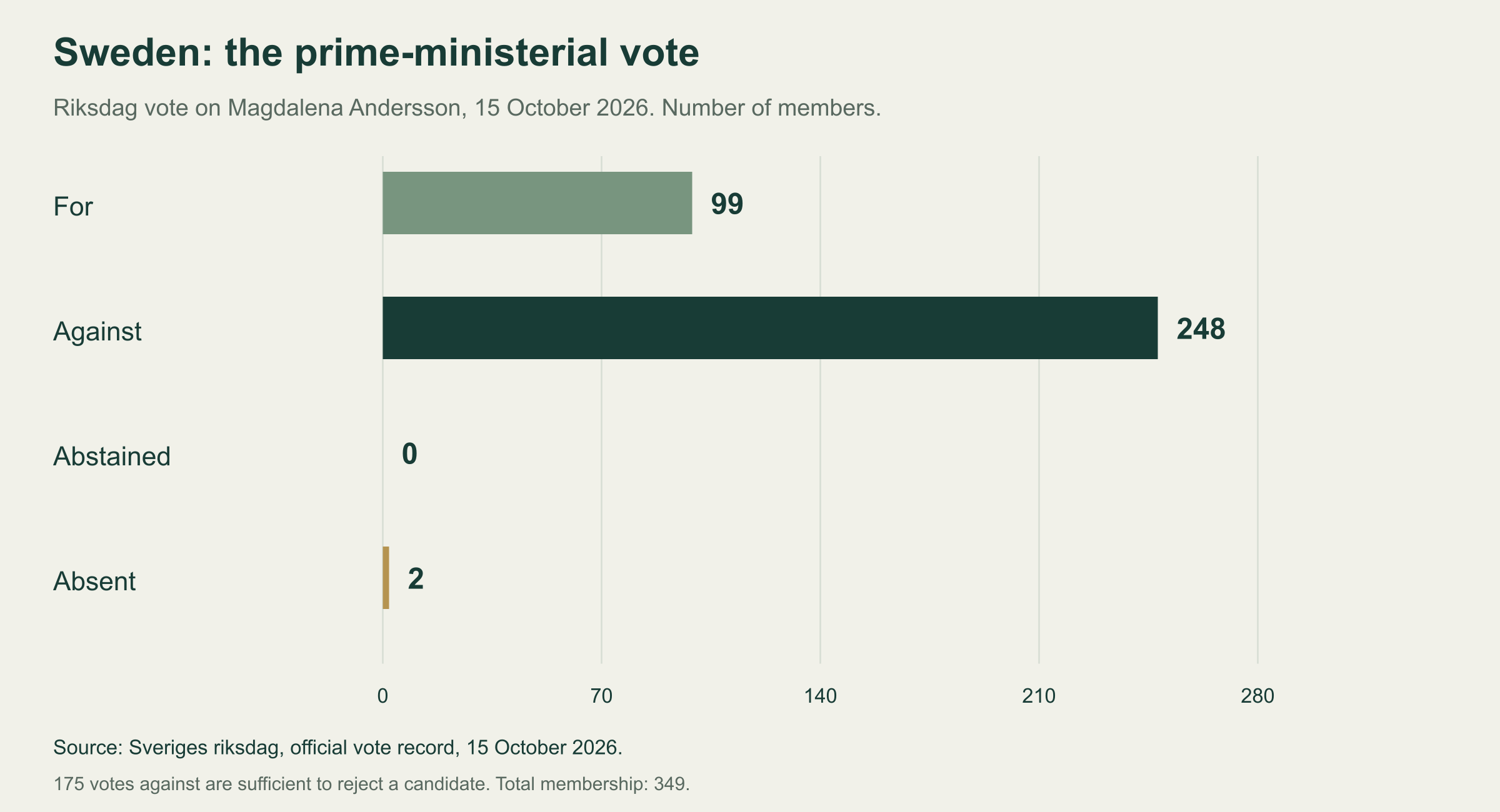
Sweden's September election produced a narrow parliamentary advantage for four centre-left parties. Together, they hold 176 of the Riksdag's 349 seats. However, disagreements over government composition have prevented them from forming a functioning coalition. On Thursday, 15 October, parliament rejected Magdalena Andersson as prime minister.
The official vote was:
| Vote | Members |
|---|---|
| In favor | 99 |
| Against | 248 |
| Abstained | 0 |
| Absent | 2 |
Only the Social Democrats supported Andersson's appointment. The other parties, including those that had expressed support for her becoming prime minister, voted against the proposed government arrangement. Ulf Kristersson remains prime minister of a caretaker government until a successor takes office.
Why the System Works This Way
Sweden uses a form of parliamentary government known as negative parliamentarism. A proposed prime minister does not need an absolute majority voting in favor. Instead, the candidate must avoid having an absolute majority vote against them. In the 349-seat Riksdag, 175 votes against a candidate are sufficient to reject the nomination. The Speaker can present up to four prime ministerial proposals. If all four fail, an extraordinary election must be held within three months.
What Happens Today?
Speaker Andreas Norlén held further consultations following Thursday's vote. According to the Riksdag's Friday announcement, he intends to provide information about the next stage of government formation today, 19 October.
The Markets Desk
Markets in perspective
Figures below are early-session observations reported on 19 October, not final daily closing prices.
Brent crude futures
$108.06 · −1.6%EARLY MONDAY SNAPSHOTU.S. crude futures
$100.70 · −0.7%EARLY MONDAY SNAPSHOTS&P 500 futures
+0.5%EARLY MONDAY SNAPSHOTNasdaq futures
+0.8%EARLY MONDAY SNAPSHOTJapan's Nikkei
−2.0%EARLY MONDAY SNAPSHOTGold
Approximately +0.4%EARLY MONDAY SNAPSHOTSource:' Monday global-markets report. Values may change during the trading session.
The Market's Central Contradiction
Oil prices are falling, providing some relief from inflation concerns. But technology shares remain vulnerable to questions about investment returns. Meanwhile, geopolitical uncertainty is supporting demand for government bonds and gold. These developments can coexist because different investors are responding to different risks.
The Krona's Recent Direction
USD/SEK · Last Five Completed Trading Sessions
12 Oct → 13 Oct → 14 Oct → 15 Oct → 16 Oct
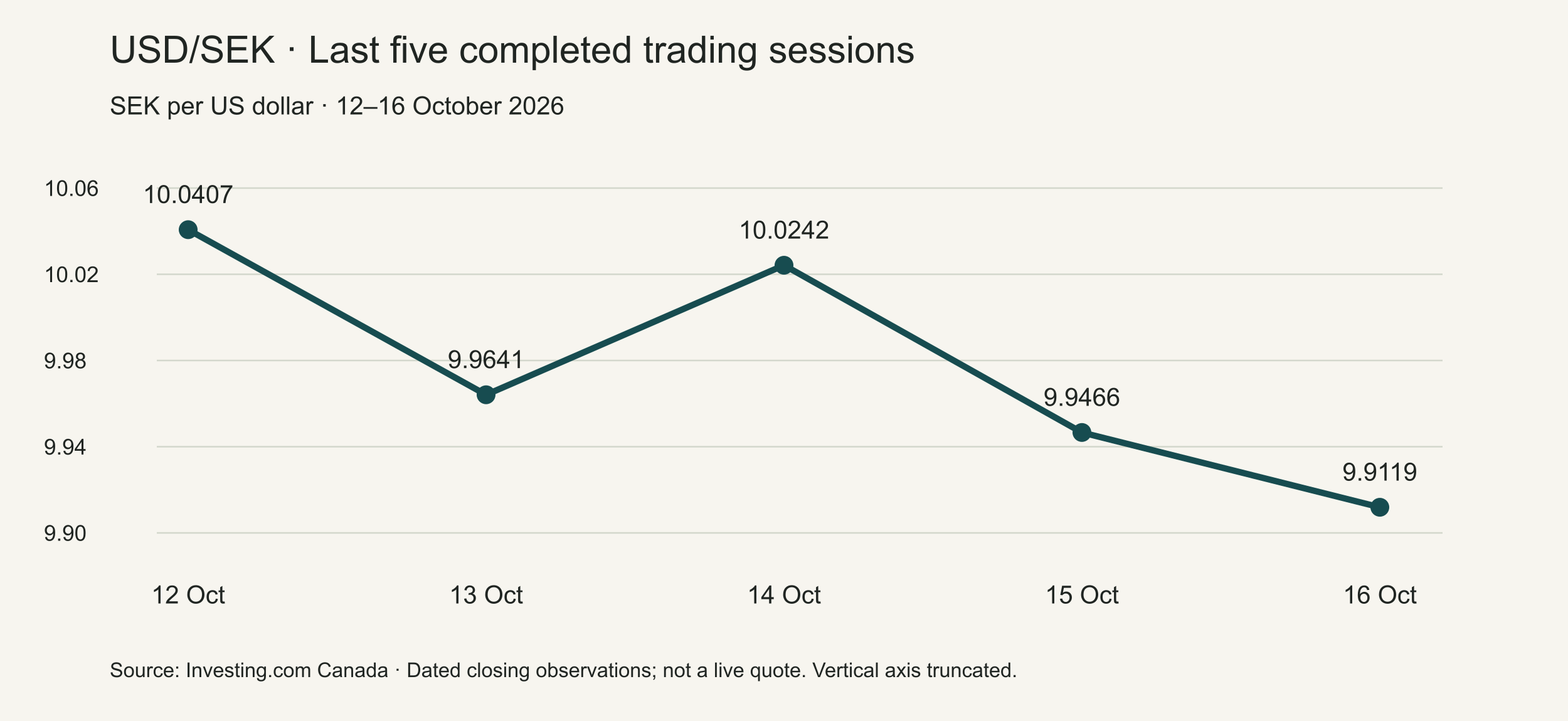
| Date | SEK per USD |
|---|---|
| 12 October | 10.0407 |
| 13 October | 9.9641 |
| 14 October | 10.0242 |
| 15 October | 9.9466 |
| 16 October | 9.9119 |
The lower USD/SEK quotation at the end of this period means the Swedish krona strengthened against the dollar over those sessions. This is a historical closing-price trend, not a forecast.
One Concept Explained
Why can oil futures fall while transportation costs remain high? An oil futures contract reflects the market price for delivery under specified terms. A company's actual delivered fuel or transportation cost can also include refining, freight, insurance, storage, contractual adjustments and local taxes. During geopolitical disruptions, these additional costs can move differently from the underlying commodity price. The distinction is important for procurement, supply-chain planning and inflation analysis.
Reuters · Global markets, 19 October ↗
Investing.com Canada · USD/SEK history ↗
Europe & the Environment
COP17 Begins With an Uncomfortable Reality

Representatives from governments, businesses and environmental organizations are gathering in Yerevan for the COP17 UN Biodiversity Conference. The conference is reviewing progress toward the international biodiversity framework adopted in 2022. One of its best-known commitments is protecting 30% of the planet's land and sea by 2030. But according to a draft UN assessment reported by, countries are not on track to meet 22 of the framework's 23 targets.
Financing is a central issue. Governments are discussing a goal of $30 billion annually in public international biodiversity finance, alongside a broader target of mobilizing at least $200 billion annually by 2030. Another major objective concerns reforming approximately $500 billion in annual subsidies associated with activities that damage nature.
Why This Matters Beyond Conservation
Biodiversity loss can affect agriculture, fisheries, water supplies, food production and the availability of natural resources. For businesses, the implications extend to supply-chain resilience and long-term operating costs. Companies dependent on agricultural commodities or biological materials may face new reporting requirements, sourcing expectations or financial incentives. The most important outcomes of COP17 may therefore concern economic policy as much as environmental protection.
The Next Inflection Point
The conference runs from 19–30 October 2026. Watch for concrete agreements on financing, subsidy reform and implementation timelines. Announcements without measurable funding or enforcement commitments would represent a different outcome from binding, operational agreements.
Life Sciences & Industrial Intelligence
AI Drug Discovery Is Moving From Experimentation Toward Larger Commercial Partnerships
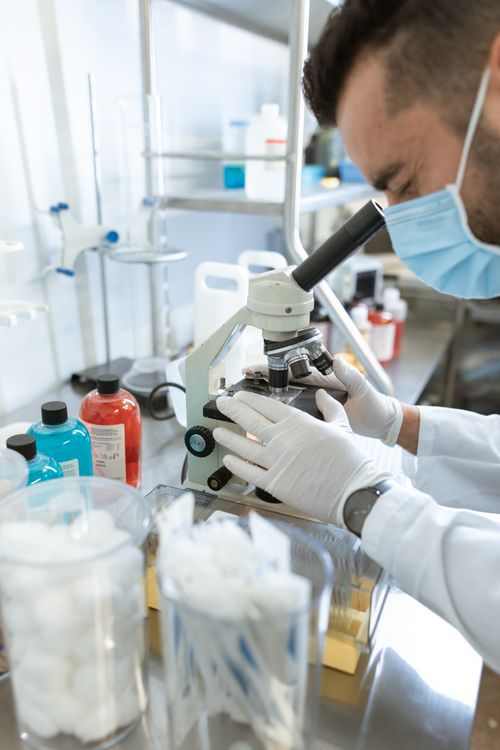
On 15 October, AstraZeneca announced a multiyear partnership with insitro. The agreement includes $40 million in upfront payments, with up to approximately $1.46 billion in potential future milestone payments, plus royalties. The companies will use AI-assisted biological research to identify potential treatments for metabolic dysfunction-associated steatohepatitis, a serious liver disease, and cardiomyopathies, which affect the heart muscle. Insitro's platform combines laboratory-grown cellular models with machine learning to investigate disease mechanisms and identify promising drug targets.
AstraZeneca will have exclusive worldwide rights to advance selected programmes. Further development and clinical validation remain essential.
What Makes This Important?
Traditional drug discovery involves identifying a biological target, developing compounds that interact with it, and testing those compounds through laboratory and clinical studies. Many candidates fail because the biological mechanism was poorly understood or because results observed in laboratory systems do not translate into human patients. AI may help researchers identify promising biological relationships earlier. However, computational predictions do not eliminate the need for rigorous experimental validation or clinical trials.
The important innovation is potentially improving the quality of decisions made before expensive development begins.
European Pharmaceutical Regulation
Two additional developments deserve attention. In an opinion adopted on 15 October and published on 16 October, a European Medicines Agency committee recommended authorization of Eli Lilly's oral GLP-1 medicine Foundayo for weight management and type 2 diabetes in adults. Separately, on 15 October, an EMA committee recommended authorization of Revolution Medicines' Rasonque for certain adults with metastatic pancreatic cancer whose disease has progressed after earlier treatment.
Both recommendations still require final European Commission decisions. The larger industry lesson: Regulatory progress, clinical effectiveness, commercial access and reimbursement are four different milestones. Approval alone does not guarantee widespread patient access or commercial success.
The Week Ahead
Five Developments Worth Watching
MONDAY · 19 OCTOBER
Sweden's government formation
The Speaker is expected to communicate the next stage of negotiations.
What matters: Whether a new candidate receives the opportunity to assemble parliamentary support.
TUESDAY · 20 OCTOBER
U.S. housing data and industrial earnings
American housing starts and building permits are scheduled, alongside earnings from major industrial and consumer-facing businesses.
What matters: Evidence about construction activity, borrowing conditions and industrial demand.
WEDNESDAY · 21 OCTOBER
Technology earnings and British inflation
Reports from Meta, Tesla and other major technology companies are scheduled, alongside the United Kingdom's consumer-price data.
What matters: AI investment returns and inflation pressures.
THURSDAY · 22 OCTOBER
U.S. labor-market indicators
Weekly initial unemployment claims are scheduled.
What matters: Whether employment conditions are weakening or remaining resilient.
FRIDAY · 23 OCTOBER
Global purchasing managers' indexes
Preliminary manufacturing and services PMIs are scheduled across major economies.
What matters: Whether business activity is expanding or contracting as the fourth quarter progresses.
Calendar checked against Newsquawk’s 19–23 October economic and earnings calendars. Scheduled releases and earnings dates can change.
Beyond Friday: Brazil's Presidential Runoff
Brazil's presidential runoff is scheduled for Sunday, 25 October.
The outcome could influence environmental enforcement, fiscal policy and the country's approach to Amazon conservation.
The result is particularly relevant given the new deforestation figures discussed later in today's Good News section.
Newsquawk · 19–23 October economic calendar ↗
Newsquawk · 19–23 October earnings calendar ↗
Riksdagen · Government formation updates ↗
Reuters · Amazon deforestation, 16 October ↗
The Wildcard
Could Genetic Databases Become a Source of Conservation Funding?
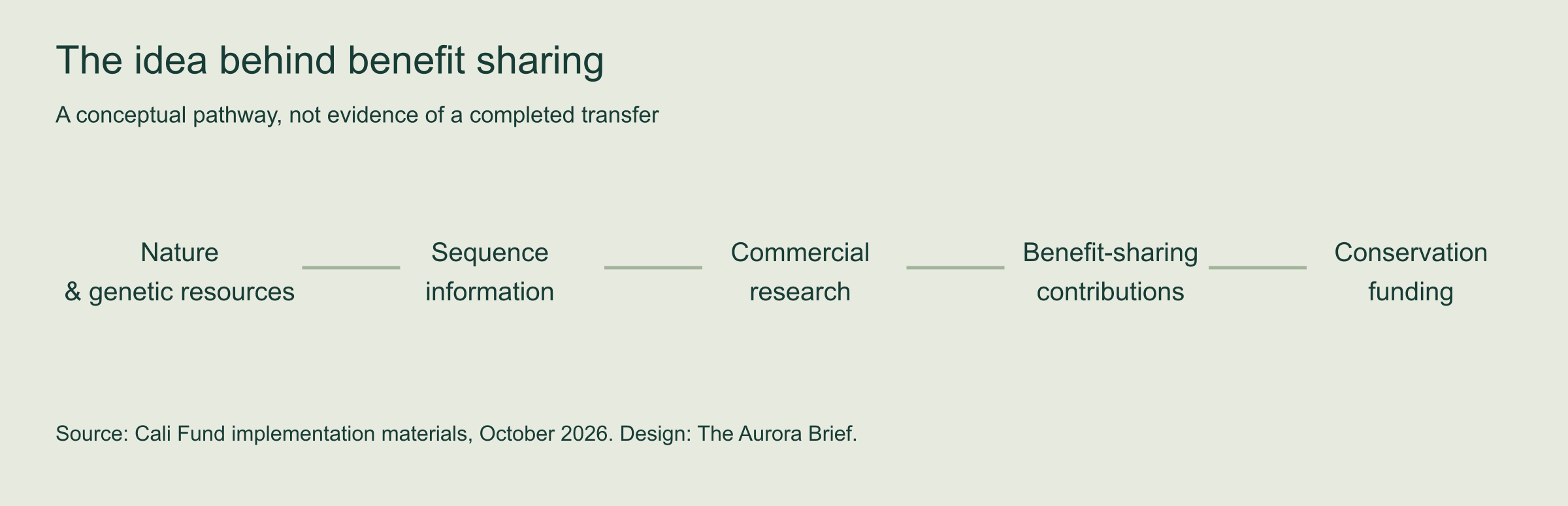
Modern pharmaceutical and biotechnology research increasingly relies on digital genetic information. Researchers can study biological sequences stored in databases without necessarily obtaining physical samples from the organisms themselves. That creates an unusual economic question. If a company uses genetic information derived from the natural world to develop a profitable product, should some of that value help finance biodiversity conservation? The Cali Fund, established in 2025, is designed to encourage contributions from businesses benefiting from digital sequence information.
The fund is relevant to pharmaceuticals, cosmetics and commercial agriculture. At COP17, negotiators are expected to discuss unresolved questions about contributions and how funding should be distributed. One difficulty is determining what proportion of a company's revenue can reasonably be attributed to the use of genetic resources. The larger idea is striking: information extracted from nature could help finance the protection of nature itself.
Good News
Three Developments Worth Celebrating
Positive reporting, with the limitations kept in view.
01 The Amazon Records Its Lowest Deforestation Rate
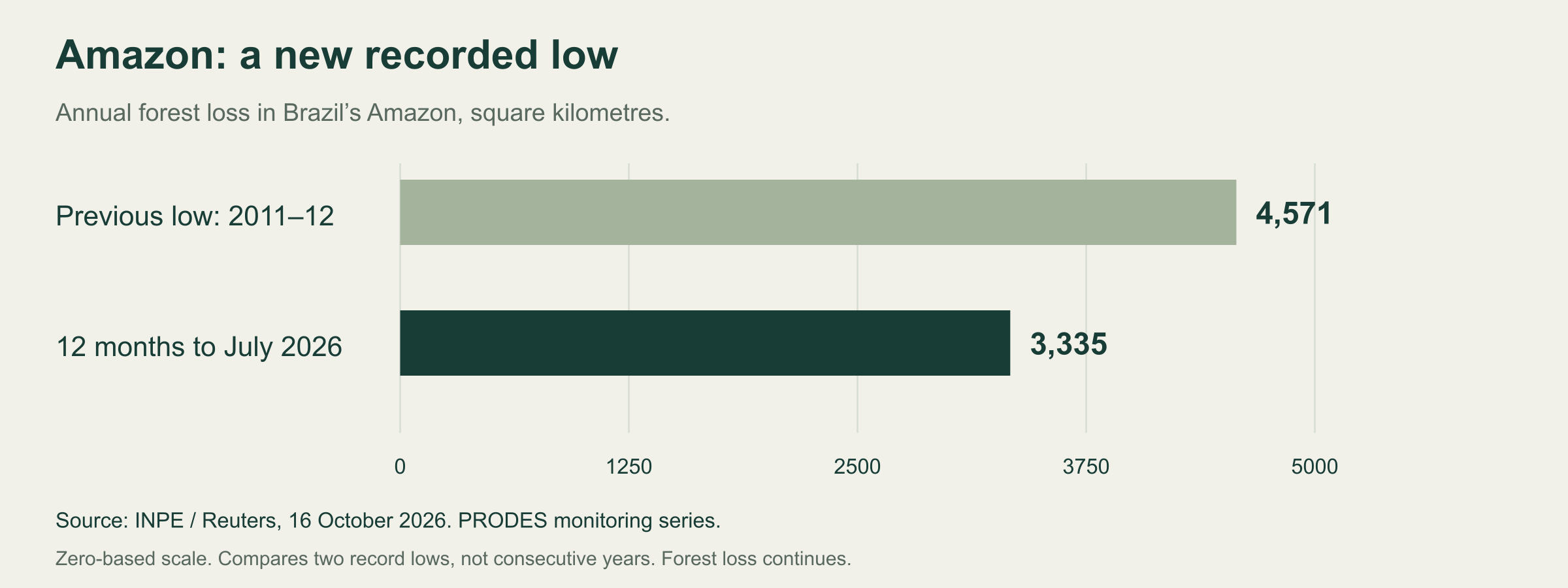
Brazilian government satellite data released Friday, 16 October, showed that deforestation in the Brazilian Amazon fell to its lowest annual level in the monitoring series beginning in 1988. Approximately 3,335 km² of rainforest were destroyed during the 12 months ending in July. That represents a reduction of about 42% from the preceding period. The previous record low was approximately 4,571 km². The figures demonstrate that substantial reductions in forest destruction are possible.
They do not mean deforestation has ended: thousands of square kilometers were still lost. Nevertheless, the decline is a significant conservation achievement.
One-year supply agreement
Source: UNICEF, reported by Reuters, 16 October.
02 A New Agreement Protects Essential Maternal and Newborn Health Supplies
The United States and UNICEF have reached a one-year, $25 million agreement intended to maintain the procurement and delivery of maternal, newborn and child-health supplies to at least 15 countries. The arrangement follows months of disruption and uncertainty surrounding international health-aid programs. Supplies covered include essential medicines and nutrition-related products. The agreement could help prevent further interruptions in countries where health facilities have already experienced shortages.
There is an important limitation: UNICEF reported that orders had not yet been placed at the time of the announcement. The agreement is therefore a meaningful step toward restoring supply continuity, rather than proof that shortages have already been resolved.

03 Twenty Rescued Sea Turtles Return to the Ocean
Indonesian authorities released 20 protected green sea turtles into the ocean near Bali after a police operation disrupted an attempted wildlife-smuggling operation. Authorities originally recovered 22 turtles. Two remained under veterinary care because they were unwell. The release demonstrates how local reporting, law enforcement and conservation organizations can work together to protect threatened wildlife. The suspected smugglers escaped, and illegal trafficking remains a serious conservation challenge.
Still, twenty animals were returned to their natural habitat. AP News
Reuters · Amazon deforestation, 16 October ↗
Reuters · Maternal health supply agreement, 16 October ↗
Associated Press · Bali turtles, 13 October ↗
The Newsroom Ledger
The Numbers Behind the Newspaper
ISSUES IN THE PERMANENT ARCHIVE
001
The inaugural edition. Published 19 October 2026.
Headline Leaderboard
Each major subject has appeared once in the Top Five.
| Subject | Appearances |
|---|---|
| Energy & geopolitics | 1 |
| Chinese economy | 1 |
| European security | 1 |
| AI & technology | 1 |
| Swedish politics | 1 |
The Optimism Index
3 positive developments documented
Environment
● ●
Maternal and child health
●
The index counts the three sourced Good News articles in this issue: two environment and conservation stories and one maternal and child health story. It is not a scientific measure of happiness or global optimism.
Biggest Verified Daily Market Movement
USD/SEK · −0.77%
15 October 2026
This is the largest absolute day-to-day percentage change in the five-session USD/SEK dataset shown above, using the provider’s published change figures. It is not a claim about all markets. Early Monday observations are excluded.
Country Highlander
No outright leader yet.
The inaugural Top Five contains reporting focused on several countries and international developments.
Country counts will become more meaningful as the archive grows.
Front Page Champion
Energy & geopolitics — 1 lead story
The first entry in what will become the publication's historical record.
World Tour
8 country focuses represented in this issue’s editorial tags: United States, Russia, China, Ukraine, Sweden, Armenia, Brazil and Indonesia. This counts selected story focuses, not every country mentioned.
The geographic archive begins today.
Your Jeopardy Answer
Who is David Ricardo?
Ricardo developed the classical theory of comparative advantage in the early nineteenth century.
The central insight is that countries can benefit from specialization and trade according to their relative opportunity costs—even when one country is more productive in absolute terms.
The Closing Perspective
The first lesson of this week's news is that an improving headline does not necessarily mean the underlying problem has been solved. Lower oil prices do not eliminate supply risks. Stronger GDP growth does not guarantee stronger household finances. Technological progress does not automatically produce attractive investment returns. And an election victory does not necessarily create a functioning government. Understanding these distinctions is what transforms information into useful knowledge.
The world rarely changes in a straight line. Progress comes from understanding both the opportunities and the obstacles that remain.
Sources & Standards
The reporting behind this edition
Reporting and original analysis are distinguished through attribution and the Executive Perspectives panels. Market observations carry their session and source; forecasts and contingent payments are labelled. File photography and editorial icons illustrate subjects rather than document today’s events.
- Reuters · Global markets, 19 October ↗
- Reuters · Sanctions review, 17 October ↗
- China National Bureau of Statistics · 19 October ↗
- Reuters · China GDP, 19 October ↗
- Reuters · Kyiv airstrike, 19 October ↗
- Reuters · Earnings week ahead, 19 October ↗
- Riksdagen · Prime ministerial vote, 15 October ↗
- Riksdagen · Government formation updates ↗
- Investing.com Canada · USD/SEK history ↗
- Reuters · COP17 preview, 19 October ↗
- Convention on Biological Diversity · Global targets ↗
- AstraZeneca · insitro agreement, 15 October ↗
- EMA · Foundayo opinion adopted 15 October ↗
- EMA · Rasonque positive opinion, 15 October ↗
- Newsquawk · 19–23 October economic calendar ↗
- Newsquawk · 19–23 October earnings calendar ↗
- Cali Fund · Implementation ahead of COP17 ↗
- Reuters · Amazon deforestation, 16 October ↗
- Reuters · Maternal health supply agreement, 16 October ↗
- Associated Press · Bali turtles, 13 October ↗
- Keynes · The General Theory, preface ↗
Source checks and changes from the chat edition
The market table uses a retrievable early Reuters snapshot: Brent $108.06 (−1.6%), U.S. crude $100.70 (−0.7%), S&P futures +0.5%, Nasdaq futures +0.8%, Nikkei −2.0%, and gold approximately +0.4%. These replace the original draft’s unsynchronised intraday figures. The USD/SEK series retains one provider throughout because close conventions differ across providers.
Foundayo’s CHMP opinion was adopted on 15 October and published on 16 October. The Bali turtle release occurred on 13 October. Statistics refer to this issue or its explicitly defined dataset. One issue is prepared; public website delivery remains pending activation.
Prepared with AI assistance from linked reporting and data, with editorial analysis; photographs and icons are illustrative.

