THE AURORA BRIEF
The world, in perspective.
BUSINESS PULSE · TUESDAY EDITION
The Cost
of Change.
Israel votes. Anthropic opens its books. Serbia prepares to govern. France puts dates to its promises. Microsoft offers a route out. After the headline comes the harder work.

Good Morning
After the headline,
the harder work.
THE EDITOR’S NOTE
Good morning from Gothenburg. Tuesday puts a practical question behind some very large headlines: who carries the cost when an institution changes direction? In Israel, voters are choosing a parliament whose eventual coalition will shape security policy. In Serbia, a student-backed movement must turn an election victory into a government. In France, an education package now has dates and financial instruments attached to it, alongside the harder task of rebuilding trust.
The business pages ask the same question in different language. Anthropic’s public offering paperwork exposes the distance between extraordinary sales growth and the long commitments needed to support it. Microsoft is offering eligible employees a route out while the industry invests heavily in new infrastructure. Money, people and authority move on different schedules. A headline can change in an afternoon; a school system, workforce or electricity grid cannot.
Today’s Business Pulse follows those connections without losing sight of the wider world. Sudan’s aid-access appeal deserves attention even when markets are busy. Our Good News section ends with two concrete developments: monitored contacts returning home in Kenya, and a substantial addition to the world’s installed wind and solar capacity. Neither solves its surrounding crisis. Both are real progress worth seeing.
Take the stories in order, or follow the front-page links. Today’s question is simple: after the announcement, what would make the change work?
The Morning Ritual
Word of the Day
Stewardship
Noun · Responsible care of something entrusted to you.
Example: Good stewardship of a school budget includes maintaining the building before the roof becomes an emergency.
Quote of the Day
“Brevity is the soul of wit.”
Polonius, in William Shakespeare’s Hamlet, Act 2, Scene 2.
The Currency Desk
USD / SEK
1 USD = 9.9558 SEK
1 SEK ≈ 0.10044 USD
Monday, 26 October 2026 reference observation. Not a live or retail conversion rate.
Source: Finanstidning, reported Riksbank seriesToday’s Jeopardy Challenge
Category: The Elements
This metallic element has atomic number 74 and the chemical symbol W, although its common English name begins with a different letter.
What is ________?
Find the answer below →The Front Page
Today’s Five Most Important Stories
01 · ISRAEL
Israel votes; the coalition question comes next
Voting is underway. The count and coalition negotiations still lie ahead.
Read the story →
02 · AI & CAPITAL
Anthropic opens the books on AI’s capital test
Extraordinary revenue growth meets long commitments and concentrated control.
Read the story →
03 · SERBIA
Serbia’s student-backed movement faces the governing test
An electoral victory opens a different challenge: running the institutions.
Read the story →
04 · FRANCE
France gives its education response a timetable
Admissions changes and building finance now have dates, with delivery still to come.
Read the story →
05 · WORK & TECHNOLOGY
Microsoft offers exits; the outcome is still ahead
About 60,000 eligible employees is not the same as 60,000 departures.
Read the story →01 ISRAEL & SECURITY
Israel votes; the coalition question comes next
Israelis are voting today in a close parliamentary election. Reuters reports a contest between Benjamin Netanyahu’s bloc and an alliance led by former military chief Gadi Eisenkot, with neither assured of a workable coalition. Voting closes at 22:00 Israeli time, or 21:00 in Sweden. There is no result in this edition.
The ballot is the first since the 7 October attacks and the subsequent wars in Gaza, Lebanon and with Iran. Netanyahu presents his security record as a reason to return him to power; opponents press the case for accountability and a change of leadership. Those are competing political arguments, not conclusions established by the vote. Reuters puts the eligible electorate at 7.3 million, citing the election committee. A caretaker period or another election remains possible if coalition negotiations fail. Reporting: Reuters via MarketScreener.
Why It Matters
A parliamentary election distributes bargaining power before it distributes executive authority. The practical sequence is seats, partners, agreement and then a government able to act. A party can improve its position without creating a majority; a victorious alliance can discover that its members disagree about what the victory authorises. That is why a strong first-night headline can coexist with weeks of uncertainty.
For people living with the consequences of war, the important question extends beyond the identity of the next prime minister. What commitments would a coalition make on civilian protection, regional diplomacy and the use of military force? Which promises would survive negotiations with smaller partners? A leadership change should not be treated as automatic evidence of a comprehensive policy reversal, just as continuity of leadership would not make every decision predetermined.
What Comes Next
The next useful evidence will be the count and the positions of potential coalition partners. Exit polls can illuminate the contest, but they cannot constitute a signed governing agreement. Readers following the evening coverage should keep those stages separate; uncertainty about the eventual government is a different thing from uncertainty about whether ballots are still being counted.
02 AI & CAPITAL
Anthropic opens the books on AI’s capital test
Anthropic made its US initial public offering paperwork public on Monday. Its first-half 2026 revenue reached $16.29 billion, compared with $1.16 billion a year earlier; its operating loss narrowed to $693 million from $2.14 billion, according to Reuters’ review. The same reporting describes more than $600 billion in compute and infrastructure commitments over a decade. Some payments are non-cancellable or apply regardless of usage. These are future contractual commitments, not a claim that this amount has already been spent. Reuters’ financial and governance explainer.
A separate Reuters report describes a much larger $80.7 billion first-half net loss, heavily affected by accounting for convertible notes. That figure must not be presented as the company’s operating loss or cash burned by serving customers. Offering terms had not been disclosed in the reporting reviewed here. The proposed Nasdaq symbol is ANT; a filing is not the start of public trading. Founder and trust arrangements would retain substantial control after a listing. Reuters on the proposed offering.
Why It Matters
This is a test of the relationship between demand and obligation. A growing service can make excellent use of infrastructure booked years ahead. The same commitments can become burdensome if customers use less than expected, prices fall or a cheaper technical approach emerges. Neither outcome follows automatically from a large contract. The decision depends on the durability and economics of the demand that sits opposite it.
Four financial questions therefore belong on different lines of the page. Revenue measures sales during a period. Operating profit or loss concerns the core business under the relevant accounting rules. Cash flow tracks money actually moving. Long-term commitments describe obligations that may extend well beyond the period. Collapsing them into one number produces drama without a usable view of the business.
Ownership and Control
There is also a control question. Buying an economic interest need not give outside shareholders equivalent authority over strategy. That can protect a long-term mission from short-term pressure; it can also reduce an investor’s ability to change course. The trade-off deserves to be understood before the spectacle of a first trading price takes over the discussion.
03 EUROPEAN POLITICS
Serbia’s student-backed movement faces the governing test
Serbia is preparing for a major parliamentary transition after the student-backed movement’s election victory. With almost all ballots counted, Reuters reported 52.7% for its candidates against 39.2% for the alliance of Aleksandar Vučić’s Serbian Progressive Party. The figures remain provisional. The identity of the next prime minister and the distribution of ministerial roles were still unclear in the reporting reviewed. Reuters on the transition.
AFP independently describes the movement’s development from protests into an electoral force. It also reports that Vučić had resigned the presidency before seeking the premiership: the parliamentary result should not be described as directly removing a sitting president. Wire accounts differ over exact seat allocations, so this edition does not present a final seat total. AFP’s account.
The immediate agenda includes a budget before the end of the year and choices about the institutions the protesters want to reform. Reuters’ analysis describes the challenge of holding together a movement whose strength came partly from its broad, decentralised character. Selecting ministers, administering services and agreeing spending priorities impose a different discipline from campaigning against an incumbent. Reuters analysis of the governing challenge.
Why It Matters
A protest coalition can agree very strongly on what should stop while remaining open about what should replace it. That is not necessarily a weakness. It becomes a practical problem only when a government needs a decision rule and no one knows who has the authority to resolve disagreement. Transparent appointments and a clear legislative agenda would make the transition easier for citizens to assess.
The budget is an early test because it turns broad principles into choices with amounts and deadlines. An anti-corruption platform needs procurement rules, oversight and enforcement. A promise to improve services needs people and funding. If the new leadership explains the sequence of those decisions, it can make progress legible without promising that every institution will change at once.
What to Watch
Foreign observers should apply the same patience. A domestic change of government does not, by itself, settle every question about relations with the European Union, Russia or China. Reading policy from an election celebration alone risks confusing a mandate for institutional reform with a mandate for every external preference an observer might hold.
04 EDUCATION & PUBLIC SERVICES
France gives its education response a timetable
France’s government has moved from promising a response to specifying an education package. AP reports a pledge to replace the Parcoursup university admissions platform by 2028, with changes planned for the 2027 admissions round. The package includes up to €4 billion in low-interest school-renovation loans through 2030 and a separate €1 billion university-renovation plan through 2029. The replacement admissions system still needs to be designed, and legal changes may be required. AP via Boston.com.
This is a material development from Monday’s earlier promise of measures. It is not evidence that buildings have already been repaired or that a new admissions process is operating. Student groups welcomed elements of the concessions while calling for continued mobilisation. Further demonstrations are planned for 31 October, with a national protest and strike day called for 5 November. Reuters also reports proposed increases in higher-education places and grants linked to inflation. Reuters on the response and student reaction.
Why It Matters
The package contains several kinds of promise that should be judged differently. A loan facility can make a project affordable to start while leaving a local authority responsible for repayment. A grant directly shifts resources. An admissions reform changes a decision process. Each requires a different delivery mechanism; adding the headline amounts together would hide those distinctions.
The timetable also matters politically. Some commitments extend beyond the current presidency, making continuity of financing and implementation central to their credibility. A student deciding where to apply next year cannot use a promise about 2028 in quite the same way as a functioning appeal route today. Short-term improvements and long-term replacement need to connect rather than compete.
Trust and Delivery
There is a broader trust problem in public services: people often meet an institution through a decision they cannot explain or challenge. Publishing understandable criteria and giving reasons for rejection can matter even before an entire system is rebuilt. That does not resolve unequal opportunity, but it gives applicants a clearer account of what has happened to them.
05 WORK & TECHNOLOGY
Microsoft offers exits; the outcome is still ahead
Microsoft has announced a time-limited voluntary exit offer for eligible employees in participating teams in Canada, India, the United Kingdom and the United States. Its public memo specifies level 70 and below, says some teams are excluded and describes financial and career-planning support. The memo does not give a final departure count. Microsoft’s announcement.
Reuters subsequently attributed to the company an eligible population of about 60,000 employees. Eligibility is not acceptance: it would be wrong to report 60,000 departures from this offer. Microsoft is due to report earnings on Wednesday, giving investors another opportunity to examine spending and the business outlook. Reuters on the offer.
Why It Matters
A voluntary programme gives employees a choice, but it does not make the organisational consequences automatic or evenly distributed. Take-up depends on circumstances that a headline headcount cannot capture. An employee approaching another opportunity may assess an offer differently from someone whose household relies on stable income. A responsible account should leave room for both experiences.
For a company, the challenge includes capability as well as cost. The people most ready to leave may carry knowledge that is difficult to replace. A reduction in payroll can coexist with a need for recruitment elsewhere. That is why the eventual composition of departures can matter more than the initial size of the eligible group.
What to Watch
The AI investment backdrop makes the announcement especially prominent, but it does not establish that every eligible role is being replaced by software. Establishing a causal claim requires evidence about particular work, staffing decisions and deployment. A company can expand infrastructure investment while reorganising teams for several reasons; those activities should not be compressed into a single unproved explanation.
THE WORLD TOUR
The World Tour — Access, confidence and Sweden’s unfinished process
Sudan: The United States and dozens of countries have called for barriers to humanitarian aid to be lifted, more funding and access through cross-line and cross-border routes, including air access to Darfur. Reuters reported the joint appeal early Tuesday after Monday’s statement. This is a diplomatic demand, not confirmation that routes have opened or deliveries have reached families. Reuters on the appeal.
Why It Matters
Aid access is a chain, not a signature. Permission, transport, staff safety and supplies all have to connect. The next meaningful evidence is delivery that can be sustained, with protection for the people doing the work. An appeal can help build pressure; its humanitarian value ultimately depends on what changes on the ground.
Brazil: Monday’s markets offered a sharp reaction to Lula’s election victory, with Brazilian shares and the real falling, according to Reuters’ Trading Day column. That is a report about investors repricing assets, not a second ballot or a verdict on every future policy. Reuters market commentary.
Sweden: The latest parliamentary update verified for this edition is Monday’s report from Elisabeth Svantesson to the Speaker and the continuation of consultations. It does not establish that a new government has been appointed. We retain that date rather than dressing an unfinished process as a fresh result. Riksdag update, 26 October.
TUESDAY BUSINESS PULSE
Business Pulse — The obligation behind the growth story
One concept: operating leverage. Imagine a fictional service with a large fixed annual bill and a small additional cost for each extra customer. When customer revenue grows, that fixed bill is spread across a larger base; profitability can improve quickly. If demand disappoints, the same fixed bill remains. This example explains a mechanism, not a forecast for any company in today’s edition.
The useful question is which costs are actually fixed, for how long and under what conditions. A cancellable experiment is different from a multi-year minimum payment. A supplier’s invoice is different from depreciation on equipment already purchased. Accounting presentations can illuminate those differences, but only when readers resist treating every expense and obligation as interchangeable.
Under the radar: continuity of knowledge. In a workforce transition, a familiar person often serves as the unwritten index to a complicated system. The cost of losing that knowledge may appear later as slower decisions, duplicated work or service problems. It is difficult to capture in an announcement, which makes it easy to overlook. Documented responsibilities and credible handovers are practical assets, even when they produce no dramatic headline.
Next inflection: watch for commitments turning into measurable outcomes. In an offering, that means pricing and final terms. In a voluntary exit programme, participation and the resulting organisation. In public investment, funded projects and completed work. This is the thread connecting today’s business and political stories: announcements change expectations first; delivery changes everyday life later.
THE MARKETS DESK
The Markets Desk — A completed session, not today’s close
DOW
+0.3%
26 Oct · US close
S&P 500
+0.7%
26 Oct · US close
NASDAQ
+0.8%
26 Oct · US close
BRENT
$115.81
26 Oct · −0.8%
WTI
$101.76
26 Oct · −1.46%
Monday’s US session ended with the Dow up about 0.3%, the S&P 500 up 0.7% and the Nasdaq up 0.8%, according to Reuters’ market commentary. Those are completed-session moves for 26 October, rounded to one decimal place. They are not Tuesday prices. Reuters Trading Day.
Oil also finished Monday lower. Reuters’ settlement report gives Brent at $115.81 a barrel, down 0.8%, and US WTI at $101.76, down 1.46%. Diplomatic hopes influenced trading, but the report did not establish a peace agreement. Reuters settlement report via Euronext.
Why It Matters
A falling oil price can ease one pressure while a high absolute price continues to burden users. Direction and level answer different questions. Likewise, a rising share index before a policy meeting tells us that buyers outweighed sellers at prevailing prices; it does not reveal what the central bank will decide. This week’s calendar is a reason to label observations carefully, not to pretend the next move is known.
The currency chart uses five completed observations from one reported reference series. It describes how many kronor were required for one dollar on those dates. A higher number means a stronger dollar against the krona within that comparison. It is neither a forecast nor the rate a bank must offer a customer. Series: Finanstidning.
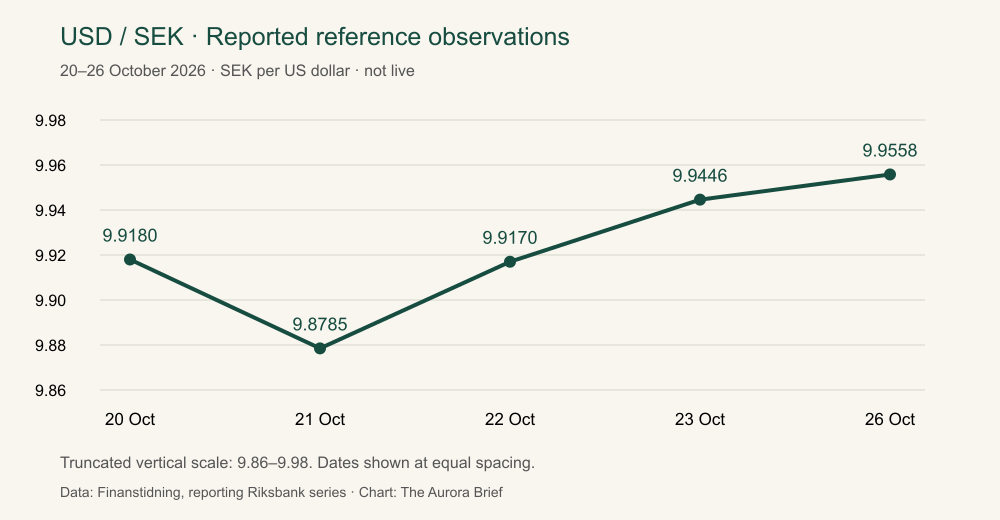
| Date, October 2026 | SEK per USD |
|---|---|
| 20 | 9.9180 |
| 21 | 9.8785 |
| 22 | 9.9170 |
| 23 | 9.9446 |
| 26 | 9.9558 |
Data: Finanstidning reporting Riksbank observations. Chart: The Aurora Brief.
Executive Perspectives
Match the price to the decision. A business paying a dollar invoice needs the relevant conversion terms and date; an energy buyer needs the contract, delivery period and currency. An index percentage is useful context, but it is rarely the same thing as an organisation’s actual exposure.
THE CALENDAR DESK
The Calendar Desk — The next points of evidence
Tuesday 27 October: Israel’s polls close at 21:00 CET. Counting and coalition discussions are separate stages; the closing time is not a promise of a settled government tonight. Reuters election reporting.
Wednesday 28 October: The Federal Reserve’s two-day meeting concludes. The statement is scheduled for 14:00 US Eastern time, or 19:00 CET, with the press conference at 19:30 CET. Microsoft reports after the US market close. The US and Europe are temporarily five hours apart because their autumn clock changes occur on different dates. Federal Reserve calendar · Microsoft reporting context.
Thursday 29 October: The ECB’s monetary-policy meeting concludes. The US Bureau of Economic Analysis schedules its advance third-quarter GDP estimate and September personal income and outlays release for 08:30 Eastern, or 13:30 CET. These are scheduled releases, not figures available to report today. ECB calendar · BEA release schedule.
Saturday 31 October and Thursday 5 November: Further French mobilisation is planned. The relevant question is how the announced education package affects participation, negotiations and implementation, rather than whether one concession can settle every grievance. AP reporting.
THE WILDCARD
The Wildcard — A kilogram without a master lump
For much of its history, the kilogram depended on a particular physical object. Since 20 May 2019, its definition has instead rested on a fixed numerical value of the Planck constant, alongside the definitions of the metre and second. The change did not make your groceries lighter. It changed the foundation on which a measurement of mass can be reproduced. Definition and effective date: BIPM.
NIST explains how instruments such as a Kibble balance connect mechanical measurements with electrical ones. The purpose is a standard that can be realised through experiment, rather than authority resting in one irreplaceable object. NIST’s explanation.
Our reflection: the lovely part of this story is that a standard can become more abstract and more practical at the same time. Most of us will never operate the experiment behind it. We still benefit from measurements agreeing when equipment, medicines or components cross borders. The everyday appearance of a kilogram conceals a remarkable act of international agreement.
GOOD NEWS · HEALTH
Good News — Twenty people can go home
Kenya has released its first 20 Ebola contacts after they completed 21 days of monitoring without symptoms, according to local reporting quoting health director Patrick Amoth. Capital FM reported the milestone on Monday. These were monitored contacts, not 20 people cured of confirmed Ebola. Other contacts remain under observation and the outbreak response continues. Capital FM, Jeremiah Wakaya.
The achievement is modest in scale and significant in human terms. For someone waiting through monitoring, going home restores ordinary choices: where to sleep, who to sit beside, how to resume the day. For a household, it ends a period in which uncertainty can crowd out everything else. That is worth recognising without converting one successful step into a declaration that the wider emergency is over.
Our perspective: public-health progress often appears as an absence. No symptoms develop; a monitored period finishes; a feared outcome does not occur. Those events can be difficult to celebrate because they do not produce a dramatic image. Yet careful follow-through is precisely what turns a protocol into something useful to a person and a community.
There is a social responsibility after the formal release as well. Completing monitoring should not become a permanent label. People returning home deserve ordinary dignity and support, not an assumption that contact with a health response defines who they are. The reassuring fact here is specific: these 20 people completed the required period without symptoms, according to the reported official account.
GOOD NEWS · ENVIRONMENT
Good News — More wind and solar are actually installed

China’s National Energy Administration reports that combined installed wind and solar capacity reached 2.01 terawatts at the end of September: 1.31 TW of solar and 0.70 TW of wind. About 170 gigawatts were added during January–September. The figures were released on 26 October, so the news is the publication of an achieved installation milestone, not a target for a later year. NEA primary release.
The same official data put wind and solar generation over those nine months at roughly 1.93 trillion kilowatt-hours. The increase met 64% of the growth in electricity consumption; that does not mean wind and solar supplied 64% of all electricity. China Daily’s English account reports the same government figures and is not an independent audit. English account and data context.
Our perspective: installed capacity is a real asset, but a rating on equipment is not the same as electricity delivered every hour. Weather, grid connections, demand and storage influence how much useful output reaches consumers and when. Recognising those constraints does not erase the achievement. It identifies the next work needed to make the investment count.
The distinction also makes this a more interesting story than a single enormous number. Building generating equipment and integrating its output are connected industrial tasks. The second determines how effectively the first changes the electricity system. More installations create opportunity; transmission, flexibility and reliable operation help turn that opportunity into useful service.
This entry is counted as one Environment development. We have not calculated avoided emissions from the capacity figure or claimed that fossil generation has disappeared. The positive result is narrower and well defined: a larger installed base and reported growth in actual wind and solar generation. Both matter, and they should be measured in their own units.
THE NEWSROOM LEDGER
The Newsroom Ledger — Progress, counted once
Including this edition, the permanent archive contains five official issues and 25 Top Five placements. Private drafts and rehearsal editions are excluded. The cumulative Good News ledger contains 13 distinct developments: Environment 5, Health 5 and Science 3. Today adds Kenya’s completed contact monitoring and China’s installed-capacity milestone, one entry each. The category shares round to 38.5%, 38.5% and 23.1%; the 100.1% total is rounding, not an extra story.
Front Page Champion: Israel leads today’s edition, beginning a one-issue streak. The World Tour visits Israel, Serbia, France, Sudan, Brazil, Sweden, Kenya, China and the United States through today’s reporting and analysis. This is a coverage list, not a ranking of national importance. Market Mover: WTI’s 1.46% fall is the largest absolute daily percentage move among the five instruments on today’s completed-session board; it is not a claim about all global markets.
The ledger follows published work, not the size of our research queue. An installation milestone, a treatment trial and a safe return home are different kinds of progress. Counting each once keeps the running record useful without pretending that every development has an equal effect on the world.
The Permanent Record
5 editions · 25 Top Five placements
13 distinct Good News developments
Private drafts and rehearsals excluded.
The Optimism Index
developments
■ Environment 5 · 38.5%
■ Health 5 · 38.5%
■ Science 3 · 23.1%
Your Jeopardy Answer
What is tungsten?
Tungsten is element 74. Its symbol W comes from wolfram, an alternative name for the element.
THE CLOSING PERSPECTIVE
The Closing Perspective — What happens after the headline
Across today’s edition, change becomes meaningful when it acquires a working form: a government, a funding structure, a comprehensible admissions decision, a handover, a return home or electricity reaching a user. The announcement deserves our attention. The follow-through deserves it for longer.
Thank you for reading. We’ll keep watching what happens next.
SOURCES & STANDARDS
Sources and Standards
Reporting cutoff: 11:45 CET, 27 October 2026. This edition was prepared and published later in the day; it is not presented as a 07:30 release. Market observations carry their own dates. Source links sit beside the claims they support. Company and government statements are attributed; analysis and perspective are the newsroom’s interpretation. File photographs are captioned as context and do not purport to show today’s events. Corrections can be sent through the site’s About page.
Prepared with AI assistance using linked reporting and data, with editorial analysis.

